Ever wonder what happened to someone you used to know, even an acquaintance? Lately, I've been wondering what happened to Barry.
Dale introduced me to Barry over two decades ago. For those of you who don't know, I met Dale through a personal ad he placed in a local newspaper. Neither of us was the other's man of his dreams, but we became great friends. I'm not sure how Dale knew Barry, but, when Dale and I were walking on the Stanley Park seawall, we'd often encounter Barry out for a stroll, usually by himself. If I remember correctly, Barry was interested in Dale.
But Dale couldn't have been less interested in Barry. I recall Dale seeing Barry approach us on the seawall and muttering unflattering descriptions of him that only I could hear, giving me the unmistakable impression Barry was not his favorite person. Still, we stopped to talk with him, as was the civil thing to do, with Dale, in his usual way, insulting Barry with offhand comments that could be taken as either funny or cruel. Dale's cruelty seemed to escape Barry; maybe he chose to ignore it.
I have to admit, Barry wasn't my type either. Lanky and unfashionably dressed, at best, he could be described as plain or average and, at worst, unattractive. His short dark hair was greasy and thinning, his teeth were discolored and crooked, and, in his late twenties or early thirties, he still had adolescent acne. Barry was a talking and walking gay stereotype: he lisped, everything he said sounded like he was shocked, and he minced.
In truth, Barry scared the hell out of me. I saw parts of me in him, and that turned me off. At the time, I remember thinking, if that's what gay looks like to the world, then please don't let me be gay. I believe Dale felt the same, although we never discussed it (this was before I'd figured out how much self-loathing is a part of most gay men). I accepted Dale's distaste for Barry and never questioned, or called him on, it. But why else would he have felt such animosity toward someone so harmless?
It's a myth that every gay man is as pretty as Brad Pitt. Sure, the gay media is filled with images of perfect gay men, their hair neatly styled, their complexions clear and natural, their bodies tanned and buff, their attire the latest from fashion runways. And, admittedly, many gay men are beautiful, making the most of what they have. But a good many aren't. In fact, I'd say the majority of gay men are plain and average, not unlike Barry, prompting me to ask the question, whatever happens to them?
Take Dale, for example, who, as I look back on it twenty years later, was no physical specimen himself. Meticulous in his personal hygiene and grooming, as well as playing up his good points and playing down his bad, Dale was an average looking gay man. Simple as that. Yet, he stood in judgment of Barry, in effect, making him no better than those who weren't gay and stood in judgment of Barry as well. If Barry couldn't count on the support of his gay brothers, who could he count on?
Am I suggesting that Dale should have given Barry more of a chance, certainly as a friend and maybe even as a partner? Perhaps. If Dale had something other than his fear of seeing himself in Barry to justify his dislike of him--for example, the sure knowledge they were not the least compatible--then fair enough. But, looking back on it, I don't know how Dale could have known he and Barry weren't suited for each other when he scarcely spoke to the guy, let alone got to know him better.
You know, I've learned one thing since Chris and I have been together, and it's this: We think we know who's right for us. But, really, we have no clue. As I've written before, Chris was not my physical idea. And, frankly, when it came to being attracted to someone, I, not unlike most gay men, placed the utmost importance on attractiveness, not character. I'm so grateful I didn't hold out for my physical ideal, because I would have missed out on the best nineteen years of my life.
Right now, there are thousands of gay men just like Barry--single, lonely, and looking for their princes. They're the ones who, if we haven't yet gotten over our own homophobia, we stare at in disbelief--either with pity or loathing. Countless gay men hang on to the hope they'll find the perfect partners, those who meet the vision of who they think they should be with, those who compensate for their shortcomings, and those who give them the love they don't have for themselves.
As I think about Barry all these years later, I hope he found someone far better than Dale. I hope he's sitting in front of a warm fireplace right now, wrapped in the arms of the man of his fondest dreams. I hope some handsome, muscular dude looked beyond his physical being and saw all the spirit and character he could ever ask for. In other words, I hope Barry is madly in love, and madly loved back, and I hope he's deliriously happy. He, and every single gay man like him, deserves it.
Thursday, November 17, 2011

Chris's Little Pile of Twigs
I wrote this post several weeks ago, and I continue to tinker with it. How three simple paragraphs confound me, when much longer and more complex posts don't, is beyond my understanding. Regardless, I hope you recognize the feeling I was trying to get across, and that you feel this way about someone you love.
 Several weeks ago, I watched from the kitchen window as Chris pruned the branches of the small barberry bush next to the shed near the back fence. I saw him take a few moments to stand several feet from the plant, assess its size and shape, and consult the pages of an old copy of the Sunset Pruning Handbook his mother had given him. Grey autumn skies overhead, Chris studied the book in his left hand, then approached the plant, placing the clipper along branches where he thought it should go and squeezing the handle. Whenever I looked up from what I was doing, there was Chris in front of the barberry, taking great care to make the right decisions about where to prune. I smiled. His patience and diligence touched me. That's the Chris I know and love. That's the man I cherish.
*
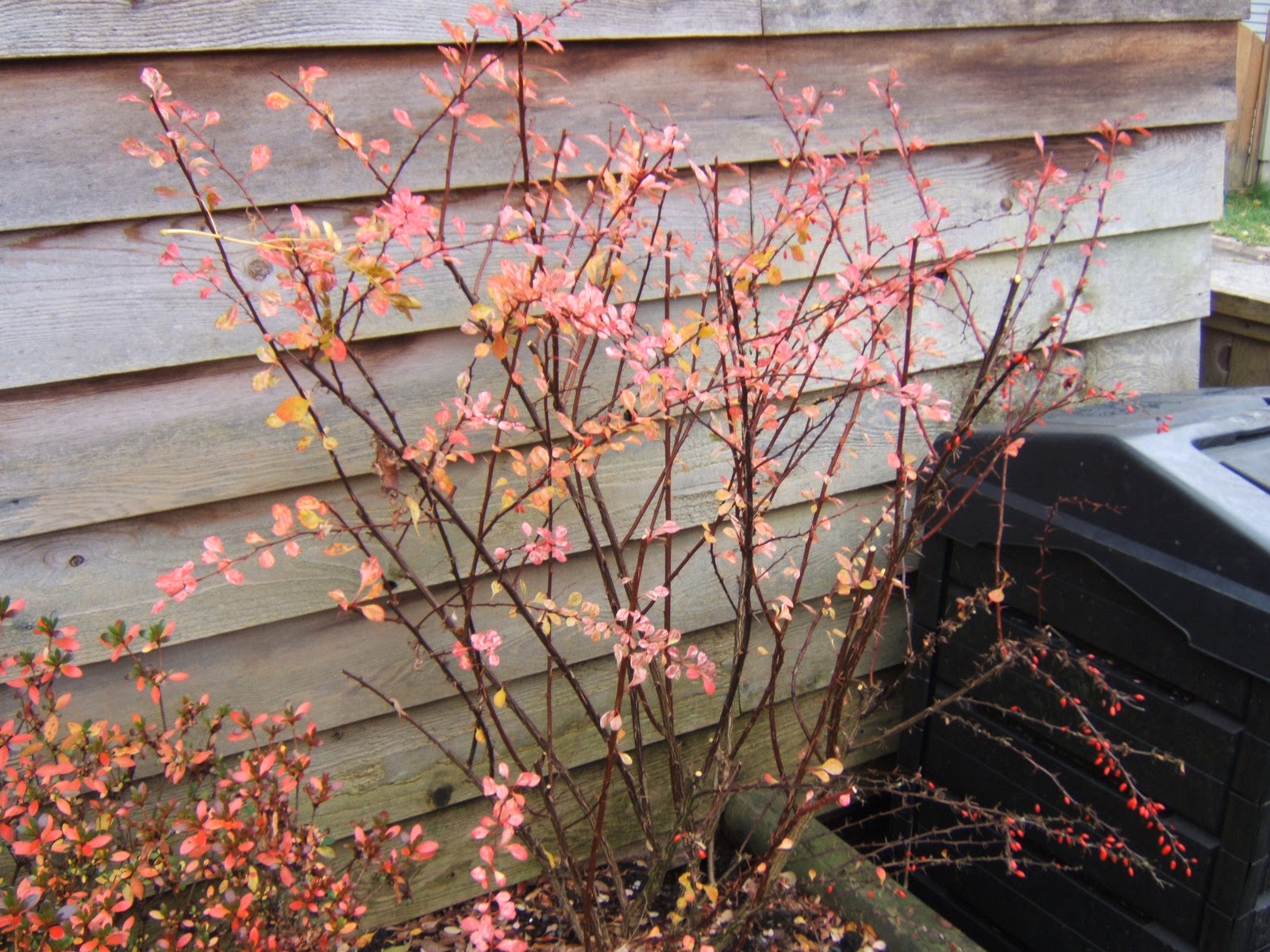
Until recently, the small pile of cut twigs from the barberry sat on the grassy boulevard in front of our house. Chris cuts branches from any other plant into small pieces and reserves them for use in our compost bin over the fall and winter, but not the barberry, because of its thorns. Instead, he placed them on the boulevard in preparation for someone from the district to drive by, as they do twice a year, to process yard debris through a chipper. In comparison to the larger, more obvious, pile of debris at our neighbor's house, Chris's pile was scarcely visible, and became less so as the large, fiery red leaves from the maple trees above fell down, covering it over. I was concerned it would be buried by the time the chipper arrived and remain there until the following spring.
Every time I went out for a run over the subsequent weeks, I saw the little pile, and thoughts of Chris came readily to mind--calculating, that Sunday afternoon, the location of each clip, taking great care not to remove too much and adversely change the shape of the plant. What I saw in front of me, sitting on the boulevard, was, to most people, a small pile of yard debris, nothing to pay any mind to. But, as the days passed, it came to represent so much more. Just last weekend, only a few days before the chipper arrived, I became aware of tears in my eyes as I walked past it. Almost hidden then by brilliant red leaves, there it was, Chris's little pile of twigs--inexplicably symbolic of the character, integrity, and beauty of the most amazing human being I know.
Monday, November 14, 2011
An Open Heart
This was a difficult piece to write. I did not enjoy visiting this dark place, one I had to admit I have. If you too are gay, perhaps you can relate to my words.
*
On one of the first episodes of the new daytime talk show "Anderson," the host, Anderson Cooper, interviewed his mother, Gloria Vanderbilt. During the course of the episode, viewers learned that, at just ten years old, Vanderbilt was the pawn in an ugly and highly-publicized custody battle between her mother and her aunt; her husband, Wyatt Cooper, died on the operating table during open heart surgery in 1978, at the age of just 50; and, ten years later, she watched as her son, Carter, jumped to his death from their fourteenth-floor New York City apartment, while she did everything to stop him.
I don't presume to suggest I've lived a life filled with the number and severity of tragedies and losses that Vanderbilt has in her eighty-seven years. And yet, you might want to ask my parents if they didn't feel a sense of loss when I came out to them; if they didn't consider it tragic when the illusion of who they hoped I was, was replaced by a stranger in some respects--someone they'd have to come to terms with and learn to love again, someone who would force them to relinquish the dream of their little boy growing up to have a normal courtship and marriage, resulting in grandchildren.
And, if you could, you might want to ask that twenty-year-old young man I once was, who, in ways he wouldn't fully understand until decades later, lost his childhood and teenage years to the fear of being something he knew he could not be; who, when he should have been playing with other children his own age, was rejected by them, making him feel isolated and alone; and whose grade school experience was a living hell, defined by unrelenting verbal and physical abuse, for no other reason than he was who and what he was, which happened to be different from everyone else.
None of us sail through life free from tragedy and loss, darkness and adversity, and all of us are affected by it in one way or another. The choice is always ours as to how we let it affect us. During the opening introduction of the episode on Vanderbilt, Cooper remarked that, despite what his mother had gone through, not only had she survived and thrived, but also she had avoided becoming hardened and tough. Instead of growing a thick skin, Vanderbilt has always remained open to people and open-hearted. While watching the program, I had to ask myself the question, could I say the same about me?
And the answer was, no, I can't. As much as it shames me to admit it, the biggest challenge I have is with people. Those who know me might be surprised to learn that. When I first meet people, I seem open and accepting enough of them. Because I know firsthand how it feels to be shunned and rejected, I go out of my way to be pleasant and personable. I'm so certain they're able to tell I'm gay that I try to disarm them, to win them over, prove with a smile, a firm handshake, or a few appropriate pleasantries that, despite what they might suspect about me, I'm still all right. I'm still worth knowing.
Foremost in my mind, of course, is always the question, what if they didn't just suspect but knew for sure I'm gay? How would they react? I look for the little signs in their demeanors and mannerisms--the hand they hesitate extending to me; the embarrassed, uncomfortable flush that crosses their faces; the stepping away from me as though I could infect them. In the event a mutual acquaintance introduces us, I wonder if he or she has said something in advance, as though my sexual orientation is the only noteworthy thing about me, as though they need to be prepared so as not to let on they know.
How much of this is paranoia on my part, and how much is out-and-out reality, I don't know for sure. But what I do know is it's my reality as a gay man, and it's colored every interaction I have with people. How can it not? It's all I've known since I was a child. My guard is always up. I'm always on the defensive. I'm always watchful and suspicious and untrusting. On the surface, I appear like everyone else--willing to embrace people, to give them a chance, even to invest in friendship. But in the back of my mind are the questions, why are you being nice to me? And, what do you want?
A process goes on inside my head. The questions run as though on a continuous reel: Would you have anything to do with me if you knew I'm gay? Are you civil to me only because you think that's what's socially expected of you? Are you going to try to get from me whatever you want, then reject me as was likely your first impulse? Do you just tolerate being around me for the good of someone else, to keep the peace, to give the illusion of being open-minded and accepting? Or do you wish you could be as far away from me as possible; wish I, and those like me, would just go away?
And even when I think I have a genuine friendship going--the other person showing me in one way or another that he or she accepts me and has no problem with my sexual orientation--I still wait for cracks to appear. I know they're there; it's a question of how close they are to the surface, the degree to which they're uncomfortable being around someone who's gay. I wonder, do they talk about me behind my back? If they do, surely, it can't be anything good. After all, I'm gay, and everyone knows gay is wrong and immoral, so why should I expect anything different. The sad fact is, I don't.
Every time we get together, they have another chance to screw up, to prove what they really think of me as a gay man. Many people say they don't have a problem with gay people, but I'm not so sure. As long as you don't get into anything too deep with them, they may not have a problem, but take the conversation to the level of those between heterosexuals and watch them squirm. Few, for example, want to know about the difficulties inherent in finding a suitable partner. Few want to hear about dating problems. And, believe me, no one wants to hear about intimate issues, physical or otherwise.
Yes, I'm an adult now, still falling back on old patterns of behavior I learned when I was in school--treating people I meet as though they're the children who bullied me, who destroyed my innocence, crushed my spirit, and forced me to be fearful of everything. But where did the children I went to school with get the idea that being gay is bad, evil, and unacceptable? From their parents, of course, from adults. Kids don't come to this realization on their own--adults lead them there, usually through teaching them religious dogma, hatred, and intolerance.
I wonder if some, many, or most other gay and lesbian people have the same challenges I do being around straight people. If they, too, would have to admit they don't have open hearts. That they've been hurt too often, at the hands of too many, for too long, to remain vulnerable and gracious and beneficent. If they've been burned so many times that they had no choice but to learn the hard lessons of what people can really be like. And, as a result, they've shut themselves off, building a wall around them and trying, usually in vain, to reduce the possibility of being hurt again.
Thursday, November 10, 2011
Thought for the Day, #42
How you feel about yourself cannot help but impact the quality of your relationships with others. Your sense of self-worth, how safe you feel with others, how much independence you need, whether or not you feel you deserve love, and how you expect to be treated by others are all determined to some extent by your core beliefs. Low self-esteem can make you feel powerless to avoid manipulation or outright abuse by others. You may feel as though you don't measure up in relationships or as if you don't deserve to be in a relationship with someone who is self-confident and healthy.
(From Loving Ourselves: The Gay and Lesbian Guide to Self-Esteem, Kimeron N. Hardin, Ph.D., p. 116)
(From Loving Ourselves: The Gay and Lesbian Guide to Self-Esteem, Kimeron N. Hardin, Ph.D., p. 116)
How Would My Life Be Different Without Homophobia?
Last week, Advocate.com asked the question, "How would your life be different if homophobia did not exist?"
I gave some thought to that and captured a number of points, in no particular order:
- I wouldn't have been bullied in school.
- I wouldn't have been embarrassed to attend classes like chorus, drama, and typing.
- I assume I would have been better liked and had more friends.
- I wouldn't have felt so different, alone, and isolated.
- I wouldn't have been embarrassed to be so athletically inept in physical education class.
- I wouldn't have had such a problem with my masculine identity.
- I wouldn't be estranged from organized religion and the Catholic church.
- My father might have loved me instead of keeping me at arm's length.
- I wouldn't have held myself back from choosing a career typical of gay men.
- I wouldn't have been consumed with self-loathing through a large part of my life.
- I wouldn't be suspicious sometimes of why people are nice to me.
- I probably would have found a partner earlier than the age of 32.
- My writing wouldn't be primarily about issues facing gay people.
- I wouldn't be fearful when I cross paths with a group of male youths.
- I wouldn't be constantly looking over my shoulder.
- I wouldn't have to be self-conscious about my effeminate mannerisms and characteristics.
- I wouldn't have to downplay who I am whenever I'm in public.
- I wouldn't have to be so conscious of wearing clothing more typical of men.
- I wouldn't be embarrassed about my ability to interior decorate.
- I wouldn't have to feel embarrassed to look at and admire attractive men.
- I wouldn't have to be worried about being gay bashed even in the gay ghetto of Vancouver.
- I wouldn't have had to worry about being held back in anything I wanted to do.
- I would have been able to be me without giving myself permission to do that.
- I wouldn't have been subjected to people calling me a faggot in public.
- Organized religion wouldn't have told me I'm evil, immoral, and destined to hell.
- I wouldn't have had to risk coming out and potentially lose those who are important to me.
- I would not have been so aware of being different from other boys.
- I would not feel invisible in the community where I live (which has few obvious gay people).
- I would be perfectly happy with who I am and never wish that I was straight.
- I wouldn't blame myself or being gay when things change or go wrong.
For better or worse, I am who I am today because I'm gay and because of homophobia. I will never know who I would have been otherwise. I guess I've always assumed life would be easier if I were straight, but do I know that for sure? I only assume that's the case because we live in a world that takes the automatic position everyone is heterosexual, and because being oneself as a heterosexual appears to be so much easier and accepted.
The other thought that comes readily to mind is, what would occupy much of my thinking today, and what would I write about, if I'd never been subjected to homophobia? There again, I have to assume I would have encountered other life challenges, in the way most heterosexual people do, and I'd be thinking, and perhaps writing, about them, in the same way many heterosexual writers take on issues close to them and create entire bodies of work around them.
But one thing is for sure: This blog would not exist if there were no homophobia. My time and effort would not go toward elevating the experience of being gay by sharing my life experience and knowledge, in the hope of helping others understand, accept, and love themselves. Would that be good or bad? Of course, in many ways, it would be good. But, in others, it would mean I wouldn't connect with so many amazing people from around the world through their thoughtful and heartfelt comments.
*
Share with me how you think your life would be different without homophobia.
Wednesday, November 9, 2011
My "It Gets Better" Video Now Live on You Tube
In case you're interested, my "It Gets Better" video is now live on You Tube. You can access it by clicking here.
My thanks to all of you who provided such positive comments about my video. I sincerely appreciate your kindness and support.
My thanks to all of you who provided such positive comments about my video. I sincerely appreciate your kindness and support.
Never Give Up Hope
Last Friday, I received the following comment on a post titled The Gay Lifestyle, which I wrote in March of this year:
Rick,
What you stated is true if you are one of the minority of gay men who wanted a relationship and has found that. Otherwise, the choices are simply to either find some other purpose in life (in other words, be a busy bee) or to seek someone out, which means being subjected to what you described as the typical gay lifestyle (you've hit the nail on the head except that you neglected to mention the high degree of mental disorders and the callous nature of adult gay men toward other gay men).
I am your age. Although I was certainly an intelligent, masculine, reasonably attractive guy, 30-plus years of searching netted nothing. Love has to happen [for a relationship], and part of that is having access to a number of [potential] partners who would be relationship-oriented and to whom I would be attracted. I have found that I can be more alone when I am with someone than when I am actually alone, so no sense putting a round peg in a square hole if the relationship doesn't work.
In addition, I have been jolted severely probably 20 or more times. I watch women who have fatal attractions to men, and I honestly cannot find the commonality that is evident in such fatal attractions. At any rate, the resultant depression from all of this has led me to job loss and financial ruin, and certainly an inability to retire. I have been in psychiatric institutions 3 times with severe depression, suffered as a result of having been emotionally jolted.
Like you, I ignore my orientation at this point although I find myself no longer wanting to associate with straight people, including family, who typically have partners and children.
This is not a good life. The structure of the male gay community is merely focused on commerce, sex and vanity. It is too late for me, but I would hope that things could be better for future generations.
I know this reader speaks for many gay men in the same situation, so I decided to feature his comment, and my response, in a dedicated post. I hope something I've written will be helpful to him and to others.
Here is my response:
Wow! Your comment is powerful in its detail and honesty. I'm taken aback because, even though I've received many comments from readers over the years--some clearly reflecting the pain they're in--I haven't gotten one quite like yours: a middle-aged gay man who's waited most of his adult life to be in a relationship, did what he could over no fewer than three decades to find one, and whose health and wellbeing suffered because of his lack of success. You are not alone; there are many just like you.
I feel your pain, I genuinely do. Even though I'm in a long-term relationship, if you’ve read some of the posts I've written here, you'll know Chris and I didn't meet until I was 32. That may sound young to you now, but I really believed at the time that was it for me--if I hadn't found someone by 30, ancient in gay years, it wouldn't happen--in the same way you believe it's now too late for you. And, believe it or not, I'd made my peace with being single and over 30. No sense being miserable; what would I gain by that?
So let me say I have no intention of writing that the man of your dreams is right around the corner (although he may well be), and, when you meet him, all the problems in your life will go away. I'm familiar with other gay men who've had the same challenges you have in finding the right person, falling in love, and building a life together. And, as much as I don't want to admit it's possible, I've had to accept not everyone finds a relationship--regardless of whether they're gay or straight. Loneliness is an epidemic.
I want you to know if I could change that reality--if I could play a hand in ensuring every single person who wants to be in a relationship is in one, fulfilling all the many reasons why they value a relationship in the first place--I would. Because I know as human beings, we're meant to love and to be loved. That's why we're here. And if we don't encounter the opportunity to share our love with, and to receive love from, a significant other, the toll can be enormous on us, physically and emotionally.
I want to respond to some of the comments you made about the gay male community in general. While it may be your experience that only a minority of gay men want relationships, I don't agree with that assessment at all. When I was in my late twenties (shortly after I came out), I knew a lot of gay men, who like me, were desperate to be in relationships. And desperate is the word. We lived for the day when it happened, and we did everything we could--within reason, of course--to make it happen.
But, for a number of reasons, I don't think finding relationships is easy for many gay men. One of biggest reasons is the contradiction between the need to love and to be loved--in our case, involving someone of the same gender--and the message we've received countless times, and internalized, that homosexuality is evil and immoral. The need to love and to be loved doesn't go away just because we're gay and supposedly evil and immoral, so many gay men redirect that need into the only option they see open to them--sex.
Another reason why I think finding relationships is difficult for many gay men is because we think we need to be blown away when we meet someone, before we consider being friends let alone partners. When I was single, I knew just the man I wanted to meet, and he was the only one I saw myself with. Then Chris came along. He was nothing like my ideal. Did I settle? Not a chance. Someone knew better than me who I needed to be with, and Chris turned out to be so much more than I ever could have imagined.
Is being gay a bitch sometimes? Sure it is. But I want you to remember we don't have to accept those parts of it that are not consistent with who we are as human beings and individuals. I've written a number of posts here to say we must be gay on our own terms. Don't buy into the commerce, sex, and vanity that you believe (as I do) are the unfortunate focus of the gay male community in general. Don't allow yourself to be defined or victimized by it. Be the gay man you were meant to be and define yourself in that way.
Even though you write that you think it's too late for you to have the relationship you've always wanted, I don't think you believe it for a minute; if you did, you wouldn't have taken the time to write or to send your comment. As long as you're still alive, my maternal grandmother would scold you, and open to the possibility, it's never too late. In her mid-eighties, she met a man her age, and they were together and happy for a number of years. You never know when what you want most will finally be yours.
In the meantime, remember you have no control over other people and what they do (including other gay men), but you have control over yourself. As a single man, think of this time as an opportunity to work on you, to be the best person you can be--for yourself and for that future significant other. And while you await the happy occasion of your paths crossing--if they do--you must find within yourself what you most want from another man. In other words, you must be your own best friend and you must love yourself.
While you work on that, take a look at your daily or weekly routine and make some small change to it. What you're doing right now hasn't yielded the results you're looking for in terms of meeting someone. To me, that means, if this is important enough to you, you must do something different. Change your attitude. Change how you look at yourself. Get involved. Become creative. Take a risk. Try something you've never done before. Don't give up. You're still far too young to throw in the towel.
And, finally, love comes in different, but no less validating, ways. With or without a life partner, you must always be open to those who love you, be they family or friends. Don't give up on straight, married people with children just because they're not gay, single, and childless. Give generously the love you have to share, and it will be returned to you tenfold. All of us have an infinite capacity to love--ourselves, family and friends, and when the time's right, a partner--and we are called upon to give it freely.
Believe.
Never give up.
The perfect man for you may enter your life today. Are you ready?
Subscribe to:
Posts (Atom)